Enzyme catalysis can make a difficult reaction faster by providing a different pathway with lower activation barriers. A study published on 9 October 2026 captured short-lived stages in the enzyme reaction that builds the penicillin ring system. For students, its value lies in understanding catalysts, reaction intermediates and molecular structure—not memorising a new antibiotic or claiming that researchers have solved antibiotic resistance.
Research-to-classroom catch-up for the 9 October briefing; published on the actual date shown above.
What did the researchers actually observe?
Patrick Rabe and collaborators studied isopenicillin N synthase, or IPNS, an iron-dependent enzyme. It converts a peptide substrate into the fused ring system of isopenicillin N. The team combined time-resolved X-ray crystallography with spectroscopy, biochemical experiments and calculations. They identified a thioaldehyde intermediate and, using a deuterium-labelled substrate, captured a monocyclic β-lactam intermediate. The evidence supports a mechanism involving reactive iron species and active-site water.
The “molecular movie” is a sequence reconstructed from structural measurements at different reaction times. It is not ordinary camera footage of one molecule. Comparing successive measurements helps researchers investigate stages that a single starting-material or product structure cannot show.
Concept 1: a catalyst changes the pathway
Activation energy is the energy barrier associated with a reaction pathway. Reactant molecules may collide frequently yet fail to react if their collisions do not have the required energy or orientation. A catalyst provides another route that can make successful transformation more likely.
For a simple reaction, the Arrhenius equation is k = A exp(−Ea/RT). Here k is the rate constant, A is the pre-exponential factor, Ea the activation energy, R the gas constant and T the absolute temperature. Holding A and T fixed, a smaller Ea gives a larger k. Real enzyme mechanisms can have several steps; this equation is a teaching comparison, not a fitted kinetic model of the IPNS study.
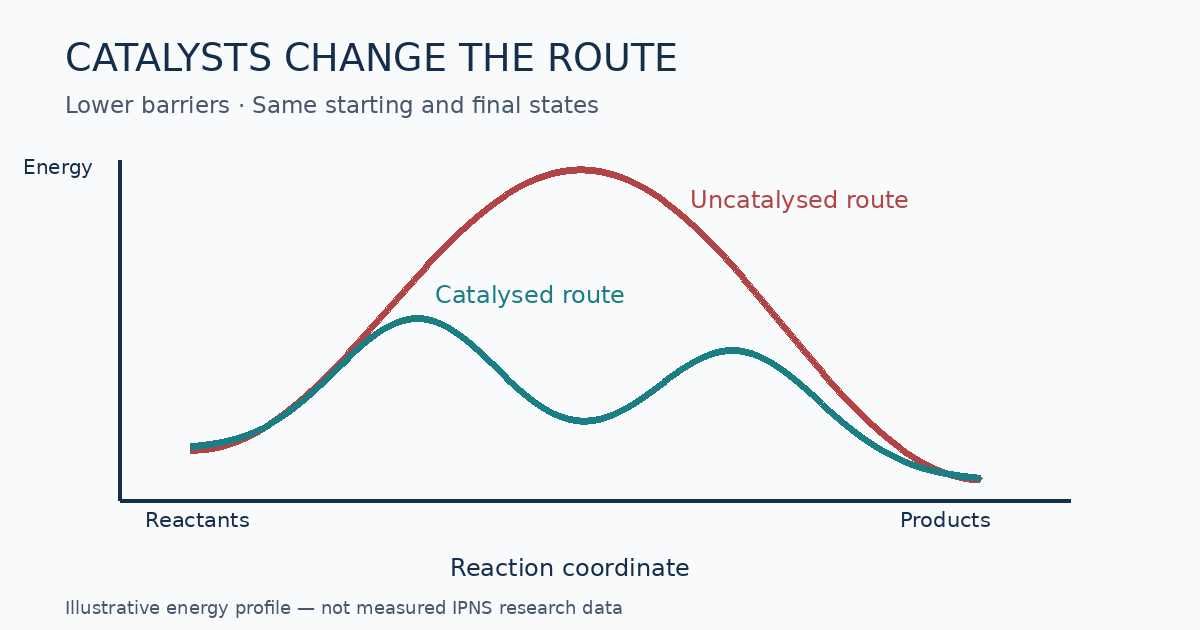
Do not confuse activation energy with the overall energy change. In an energy-profile diagram, the barrier concerns the climb from a reactant state towards a transition state. The overall change concerns the difference between starting and final states. Lowering the climb does not automatically change where the journey ends.
For a specified reversible reaction at fixed temperature, a catalyst does not change its equilibrium constant. It accelerates approach to equilibrium by catalysing the forward and reverse pathways. Biological systems can also involve coupled reactions and continuous material exchange; that does not mean catalysts overturn thermodynamics. Compare this distinction with our Haber-process guide to equilibrium and reaction rate.
Concept 2: an intermediate is not a transition state
An intermediate is formed in one step and consumed in a later step. A useful schematic is A → I → B, where I denotes an intermediate. It can sometimes accumulate sufficiently for detection, even if it is too unstable to isolate in a bottle.
A transition state is the configuration at a barrier between states. It is not the same thing as an intermediate. On a conventional reaction-coordinate profile, an intermediate occupies a local minimum; a transition state lies at a maximum along the pathway. A multistep mechanism therefore has more than one barrier.
Knowing the overall transformation A → B does not prove that I exists. Researchers need evidence that discriminates between possible pathways. An experimentally supported mechanism is stronger than a plausible sequence drawn only because it produces the correct product.
The study illustrates why measurements of structure, electronic behaviour and reaction timing can complement one another. Students should ask: which part was observed, which part was inferred, and which alternative explanation remains possible?
Concept 3: molecular structure helps explain chemical behaviour
A β-lactam is a four-membered cyclic amide. The prefix β describes the lactam ring classification; it is not a charge or an oxidation-state symbol. Small rings can impose geometric constraints that affect bonding and reactivity. A ring drawing is therefore more than a way of arranging atoms neatly on paper.
Students can recognise amide connectivity as –C(=O)–N–. Identifying that group is different from predicting an entire enzyme mechanism. The peptide substrate, metal centre, surrounding protein and water network form a chemical environment that cannot be reduced to a single familiar functional-group reaction.
The structure–property habit is useful elsewhere too. Our lesson on intermolecular forces and vapour pressure shows why one structural feature rarely explains a whole experimental result.
Why does the result matter—and what does it not prove?
The work provides evidence about previously elusive stages in an enzyme-catalysed ring-forming reaction. Such understanding may inform future catalyst or enzyme design. This is mechanistic research supported by several methods, not a clinical trial.
It does not demonstrate a new approved antibiotic, successful treatment of resistant infections, cheaper commercial production or a universal rule for every iron enzyme. Structural snapshots also require interpretation alongside complementary evidence. Avoid turning “may inform future design” into “has delivered a new medicine.”
CBSE, JEE and NEET relevance
CBSE: use the example to reinforce Chemical Kinetics, the role of catalysts and enzyme concepts in Biomolecules. Ring and functional-group recognition provides additional organic-chemistry enrichment.
JEE: distinguish a rate constant from equilibrium composition, read multistep energy profiles, and separate intermediates from transition states.
NEET: revise enzyme catalysis, activation energy and functional groups. Students do not need to memorise this research for the examination. For further practice, use Topper Formula’s free study resources; the linked research is enrichment, not an official PYQ.
Student practice: five original concept questions
1. A catalyst increases a reaction’s rate. Must ΔG° become more negative?
Answer: No. A catalyst changes the route and kinetic barriers, not ΔG° for the specified overall reaction. Faster does not mean more thermodynamically favourable.
2. A two-step profile has two maxima separated by a minimum. What does the minimum represent?
Answer: An intermediate. The maxima represent transition states for the successive steps; they are not stable substances that can be collected.
3. At 300 K, lowering Ea by 5.0 kJ mol⁻¹ changes k by what factor if A stays constant?
Answer: knew/kold = exp[5000/(8.314 × 300)] ≈ 7.4. Convert kilojoules to joules before substituting. This is an illustrative calculation, not a measured result from the paper.
4. Why is observing an intermediate stronger evidence than knowing only the final product?
Answer: Different pathways can yield the same product. An intermediate constrains the possible sequence, although other measurements are still needed to support its mechanistic role.
5. Does a more detailed enzyme mechanism prove that a better antibiotic is available?
Answer: No. Mechanistic insight and a medicine’s effectiveness, safety and approval are separate evidential questions.
Record the reason behind a wrong answer using our error-notebook method for analysing test mistakes, rather than memorising the answer alone.
Quick answers
Do enzymes change the equilibrium constant?
For a specified reaction at a fixed temperature, enzyme catalysis does not change the equilibrium constant. It changes the available kinetic pathway and how quickly equilibrium is approached. In cells, coupled reactions and continuous exchange of materials can influence overall behaviour, but those conditions must be distinguished from the catalyst’s effect on a single reaction.
Can a short-lived intermediate be detected?
Yes, if a suitable method measures the system on the relevant timescale or conditions allow the intermediate to accumulate. Time-resolved measurements can reveal states missed by a static product analysis. Detection is not the same as isolating a pure stable substance, and interpreting an intermediate’s role requires additional chemical evidence.
Is a molecular movie an ordinary video?
No. In this context, researchers combine structural snapshots collected at different reaction times to reconstruct chemical progression. The resulting visualization communicates changes inferred from experimental measurements. It should not be described as an ordinary camera following one molecule continuously, nor should an illustrative animation be mistaken for raw experimental footage.
Original research and author
Rabe, P., Makita, H., Southwart, R. et al. Unanticipated intermediates during isopenicillin N synthase catalysis identified by time-resolved X-ray free-electron laser studies. Nature Catalysis, published 9 October 2026. DOI: 10.1038/s41929-026-01618-4. See also the University of Oxford’s explanation.
For a shorter educator reflection on what this research can teach students about scientific reasoning and catalysis, read What a Penicillin Molecular Movie Can Teach Students About Catalysis.
Lalit Kumar Mishra — Chemistry Educator • Student Success Mentor • Author. Founder of Topper Formula, an education and learning brand.
Pingback: Haber Process Explained: Temperature, Yield & Rate